
Flocked Swabs vs. Fiber Wound Swabs: The Performance Gap That Shows Up in PCR Results

The price difference between flocked nylon swabs and traditional fiber-wound swabs is visible enough that procurement teams regularly ask whether the premium is justified. For most molecular diagnostic applications, the answer is straightforward — but it depends on what you're using the swab for and how much the test sensitivity matters to the end user.
The structural difference is what drives the performance gap. A traditional fiber-wound swab has an absorbent matrix where fibers are layered and intertwined. Sample material — cells, mucus, viral particles — gets drawn into this matrix on collection. When the swab is placed into transport media and agitated, some of the captured material releases, but a significant fraction stays trapped within the fiber matrix. Studies comparing elution efficiency between swab types consistently show that fiber-wound cotton swabs retain more sample than they release, with elution rates that vary widely depending on the fiber type, winding density, and transport media used.
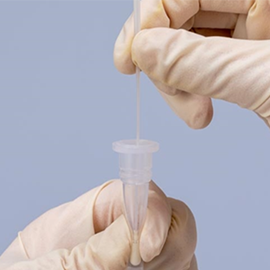
Flocked swabs work differently. Short nylon fibers are applied perpendicular to the swab tip through electrostatic flocking, creating a brush-like surface layer with no deep matrix. Sample material sits on or near the surface of this fiber layer rather than being absorbed into it. When the swab is expressed into transport media, capillary action in reverse releases the captured material efficiently — elution rates above 90% are typical for well-manufactured flocked swabs. For nucleic acid testing where the input template amount affects detection sensitivity, that difference in elution efficiency translates directly to cycle threshold values and, at low pathogen concentrations, to whether the test returns a positive or negative result.
Where fiber-wound swabs remain appropriate is in applications where elution efficiency isn't the critical variable — surface sampling for environmental monitoring, collection for culture methods that don't depend on precise input volumes, or screening workflows where sensitivity requirements are modest. Replacing fiber-wound swabs with flocked swabs in every application doesn't make sense and adds cost without benefit. For PCR-based diagnostics, the calculation is different. Changfeng Medical can provide elution efficiency data for our flocked swab products on request.